
Purpose-Built Vial Stoppers for Controlled Freeze-Drying and Final Closure
Freeze-drying places very different demands on a pharmaceutical stopper than ordinary liquid vial packaging. During lyophilization, vapor must escape from a partially stoppered vial; once drying is complete, the stopper must seat correctly and become part of the final container-closure system.
Supply-Packagings supplies grey lyophilization rubber stoppers for pharmaceutical, biotechnology, diagnostic, veterinary, and compatible laboratory vial systems.
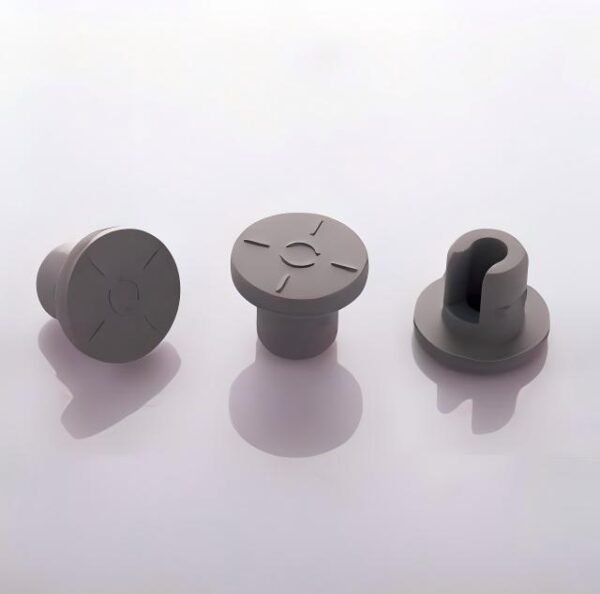
The stopper shown has a broad circular flange and a lower plug with an open side channel. This type of geometry is commonly associated with freeze-drying applications because the channel can support vapor flow while the stopper is held in the intended partial-seating position.
Key Product Benefits
✓ Vented plug geometry designed for compatible lyophilization workflows
✓ Broad flange provides a defined sealing and compression area after final stoppering
✓ Bromobutyl and chlorobutyl rubber options available
✓ Standard, siliconized, coated, and project-specific surface configurations can be evaluated
✓ Common pharmaceutical vial sizes available
✓ Compatible clear or amber glass vials can be supplied
✓ Matching aluminum crimp seals and flip-off caps available
✓ OEM and ODM support for stopper dimensions, materials, treatments, and packing
✓ Factory-direct manufacturer and wholesale supplier for pharmaceutical custom packaging projects
Product Overview
This component is a pharmaceutical elastomeric closure designed for compatible glass vials used in freeze-drying processes.
Visible structural features include:
- Wide circular sealing flange
- Central top access region
- Molded identification features on the top
- Cylindrical lower plug
- Open side channel or slot in the lower plug
Common international purchasing names include:
- Lyophilization stopper
- Lyo stopper
- Freeze-drying rubber stopper
- Vented vial stopper
- Slotted vial stopper
- Butyl rubber vial stopper
- Pharmaceutical freeze-drying closure
Exact use should always be confirmed by technical drawing and process qualification rather than appearance alone.
How the Lyophilization Stopper Works
Partial Stoppering Before Freeze Drying
After filling, the stopper is positioned in the vial at a specified partial-seating height. It must remain sufficiently stable for loading and chamber operation.
Vapor Escapes Through the Open Path
The lower slot or vent structure allows vapor to pass between the vial interior and lyophilizer chamber while the stopper remains partially seated.
Final Stoppering Inside the Chamber
After the drying cycle reaches the validated endpoint, the lyophilizer’s stoppering mechanism presses the stopper fully into the vial.
Aluminum Closure Is Applied
An aluminum crimp seal or aluminum-plastic flip-off cap can then mechanically retain the stopper according to the validated production process.
Why Vent Geometry Matters
Vapor Flow Can Be Restricted
A stopper without appropriate flow paths can impede vapor removal during lyophilization if used in an unsuitable configuration.
Partial Seating Must Remain Stable
The stopper needs to remain positioned during loading, vacuum application, primary drying, and secondary drying. Plug geometry must therefore work with the vial neck.
Final Seating Must Be Predictable
A poorly matched stopper may tilt, bind, or require excessive force when fully seated.
Stopper Stack Height Affects Crimping
Flange thickness contributes to the combined vial, stopper, and aluminum closure stack. This affects crimp settings and final closure appearance.
Solving Common Buyer Problems
Stopper Pops Out During Processing
Vial bore, stopper diameter, elastomer recovery, partial insertion depth, and process conditions can all influence stability.
We recommend qualification using the actual vial and freeze-drying process.
Stopper Is Difficult to Fully Seat
Excessive interference or unsuitable surface friction can affect final stoppering. Material, dimensions, and surface treatment should be evaluated together.
Crimp Caps Sit Too High or Too Low
Stopper flange height and final compression influence the aluminum closure profile. Matching all components helps reduce setup problems.
Stoppers Stick in Feeding Equipment
Surface treatments such as controlled siliconization or coating can be evaluated when appropriate for the process.
Different Suppliers Create Tolerance Conflicts
Supply-Packagings can coordinate the stopper, pharmaceutical bottle or vial, and aluminum closure to reduce cross-supplier compatibility issues.
Material Options
Bromobutyl Rubber
Commonly selected for pharmaceutical vial closures due to low permeability and useful chemical resistance characteristics.
Chlorobutyl Rubber
Widely used in pharmaceutical packaging and available for projects where it fits the formulation and process requirements.
Surface Treatments
Depending on the application, configurations may include:
- Controlled siliconization
- Polymer coatings
- Reduced-friction treatments
- Specialized barrier treatments
Selection should be supported by product compatibility, extractables and leachables, particulate, processing, sterilization, and stability evaluation.
Technical Specifications
| Parameter | Available Options |
|---|---|
| Product Type | Pharmaceutical lyophilization rubber stopper |
| Material | Bromobutyl / chlorobutyl |
| Standard Color | Grey |
| Structure | Flange + vented or slotted plug |
| Common Sizes | 13mm / 20mm and project-specific dimensions |
| Top Design | Defined central access area |
| Surface | Standard, siliconized, coated by project |
| Compatible Container | Pharmaceutical crimp-neck glass vial |
| Compatible Closure | Aluminum crimp seal / flip-off cap |
| Application | Freeze-dried pharmaceutical and diagnostic products |
| OEM | Standard specifications with project-specific treatment |
| ODM | Custom geometry subject to feasibility and volume |
| MOQ | Depends on material, size, surface treatment, and packing |
| Samples | Available for selected standard models |
| Packing | Sealed inner bags and reinforced cartons |
| Shipping | Sea, air, express |
| Trade Terms | FOB, CIF, DDP depending on destination |
Final elastomer formulation, stopper dimensions, cleanliness level, sterilization status, coatings, processing compatibility, and documentation must be agreed for the individual pharmaceutical program.
Matched Pharmaceutical Packaging Components
Clear Glass Vials
Suitable for products where visual inspection is required.
Amber Glass Vials
Available where additional light shielding forms part of the product stability strategy.
Aluminum Crimp Seals
Open-center and other aluminum closure configurations are available.
Aluminum-Plastic Flip-Off Caps
Colored flip-off caps can provide convenient access and SKU identification.
Secondary Packaging
Custom vial trays, carton dividers, folding boxes, labels, and transport packaging can also be coordinated.
Industries Served
🧪 Pharmaceutical Containers — freeze-dried drugs and compatible injectable vial products
🔬 Biotechnology — proteins, peptides, biological preparations, and research products
🧫 Diagnostics — freeze-dried reagents, controls, standards, and calibrators
🐾 Veterinary Pharmaceuticals — compatible freeze-dried veterinary products
🏥 Contract Manufacturing — facilities providing vial filling, lyophilization, stoppering, and crimping
🧴 Specialty Cosmetic Packaging — selected professional freeze-dried skincare systems
Application Scenarios
◇ Freeze-drying vial filling lines
◇ Partial stoppering before chamber loading
◇ Pharmaceutical powder products intended for reconstitution
◇ Diagnostic reagent lyophilization
◇ Biotechnology vial packaging
◇ Veterinary freeze-dried product packaging
◇ Multi-vial clinical kits with coordinated caps and cartons
Product Advantages
Designed for Freeze-Drying Workflows
The vented lower structure is intended to support vapor movement when the stopper is correctly partially seated in a compatible vial.
Matched Closure System Support
The stopper can be evaluated together with glass vials and aluminum caps, helping technical teams reduce dimensional uncertainty during qualification.
Multiple Material and Surface Configurations
Bromobutyl, chlorobutyl, coated, and siliconized options allow buyers to evaluate a configuration that fits the formulation and production process.
OEM and ODM Capability
OEM programs can use existing stopper models with defined material, treatment, and packing requirements. ODM projects can evaluate proprietary stopper geometry where commercial and technical conditions support new development.
One Supplier for Broader Packaging
Supply-Packagings supports stopper projects alongside pharmaceutical bottles, jar packaging, supplement packaging, flexible pouch products, aluminum closures, and paper cartons for consolidated wholesale procurement.
Quality Control
Depending on the agreed specification, inspection can include:
⬢ Flange diameter and thickness
⬢ Plug outside diameter
⬢ Vent-slot geometry
⬢ Stopper overall height
⬢ Surface and molding quality
⬢ Fit evaluation with reference glass vials
⬢ Partial-seating and final-seating trial support
⬢ Stopper and cap stack-height checks
⬢ Packing cleanliness and lot traceability
For pharmaceutical applications, final qualification should include all testing required by the drug manufacturer and relevant regulations, potentially including extractables and leachables, penetration, fragmentation, reseal performance where applicable, container closure integrity, sterilization compatibility, and stability studies.
Packaging and Logistics
Controlled Component Packing
Rubber stoppers can be supplied in sealed inner bags with lot identification and reinforced outer cartons. Packaging can be configured according to the customer’s subsequent washing, sterilization, filling, and lyophilization process.
Sterile or ready-to-use condition should never be assumed and must be explicitly included in the agreed specification.
Global Shipping
Sea freight is suitable for larger wholesale quantities. Air freight can support urgent programs, while express courier is recommended for samples and qualification quantities. DDP shipping can be evaluated for selected destinations.
Frequently Asked Questions
Q1. What type of stopper is shown in this image?
Its broad flange and open side channel are consistent with stopper geometries commonly used in pharmaceutical lyophilization. Final identification requires the technical specification.
Q2. Why is there a slot in the lower stopper plug?
In a compatible freeze-drying system, an open channel can provide a path for water vapor while the stopper is partially seated.
Q3. Can you provide bromobutyl and chlorobutyl versions?
Yes. The suitable material depends on formulation compatibility, processing, sterilization, and qualification requirements.
Q4. Are 13mm and 20mm options available?
Yes. These are common vial closure specifications. Additional dimensions can also be evaluated.
Q5. Can you supply matching vials?
Yes. Clear and amber pharmaceutical glass vials can be coordinated with the stopper.
Q6. Can you supply flip-off caps and aluminum seals?
Yes. Multiple pharmaceutical closure styles and colors are available for compatible vial systems.
Q7. Are the stoppers supplied sterile?
Supply condition depends on the specific product configuration. Sterility, washing, ready-to-sterilize status, or other requirements must be explicitly specified.
Q8. How do we select the correct stopper?
Provide the vial neck dimensions, existing stopper sample or drawing, lyophilization process requirements, preferred elastomer, annual quantity, and destination market.
Buyer Feedback
★★★★★ More predictable seating during freeze-drying trials
“The vented stopper design matched our vial neck well and remained stable during our process evaluation.”
— Process Development Engineer, Biotechnology Company
★★★★★ System sourcing made qualification easier
“We evaluated the glass vial, lyo stopper, and aluminum closure from one specification package. It reduced compatibility questions substantially.”
— Packaging Manager, Pharmaceutical Manufacturer
★★★★★ Repeat dimensions remained stable
“The slot geometry and flange dimensions matched our approved samples across repeat deliveries.”
— Procurement Lead, Contract Filling Facility
Related Product Categories
- Lyophilization Rubber Stoppers
- Injection Vial Stoppers
- Bromobutyl Stoppers
- Chlorobutyl Stoppers
- Pharmaceutical Glass Vials
- Penicillin Bottles
- Aluminum Flip-Off Caps
- Open-Center Aluminum Seals
- Pharmaceutical Containers
- Bottle Packaging
- Supplement Packaging
- Jar Packaging
- Flexible Packaging
- Pharmaceutical Folding Cartons
- Custom Packaging Services
Visit our products page for complete packaging development support.
Request a Lyophilization Stopper Match
Send your vial neck size, glass vial drawing or physical sample, current stopper specification, freeze-drying application, elastomer requirement if known, annual quantity, and destination market. Providing your current vial, stopper, and aluminum closure together is the fastest route for preliminary system matching.
Supply-Packagings provides OEM, ODM, factory-direct manufacturing and wholesale custom packaging support for pharmaceutical stoppers, glass vials, bottle components, aluminum closures, jars, pouches, trays, and secondary cartons.
For technical matching, qualification samples, MOQ, production lead time, and international delivery, Contact Us.
评价
目前还没有评价